History & Characteristics
The Italian Greyhound is one of the oldest toy breeds in existence, with a history that stretches back over two millennia. Skeletal remains resembling the breed have been excavated from archaeological sites in Egypt and southern Europe, and depictions appear in Roman mosaics and frescoes from the first century CE. The breed was well established in the Italian peninsula by the Renaissance period, when it became a coveted companion among the nobility and wealthy merchant class of Florence, Milan, and other city-states. Renaissance portrait painters regularly depicted Italian Greyhounds alongside their aristocratic owners — canine accessories that served as symbols of refinement and gentle luxury.
The breed’s continental popularity spread to Northern Europe through the 16th and 17th centuries. Frederick the Great of Prussia kept Italian Greyhounds as companions throughout his life, reportedly preferring their company to that of most people. Catherine the Great of Russia, Queen Victoria of England, and James I of Scotland were among the European royals who prized the breed. The AKC recognized the Italian Greyhound in 1886, among its earliest registrations.
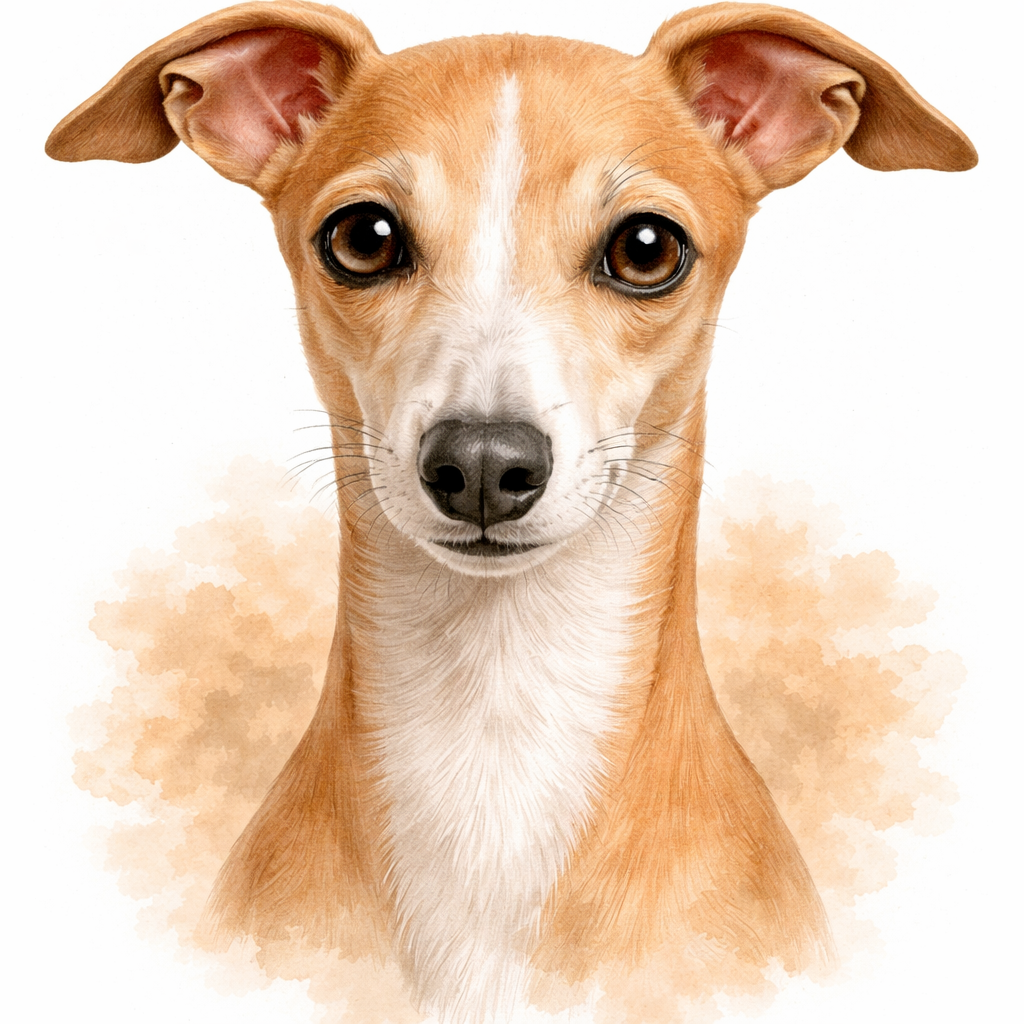
While the Italian Greyhound shares the aerodynamic sighthound silhouette with the full-sized Greyhound, it was developed not as a working hunting dog but as a lap companion — though it retains the prey drive and speed that characterize all sighthounds. The AKC breed standard describes a dog weighing 7–14 pounds (approximately 3.6–5 kg), with the same distinctive arched back, narrow head, high-set folded ears, deep chest, and tucked abdomen seen in larger sighthounds. The coat is extremely short and fine — often described as satin-like in texture — and comes in a wide range of colors including seal (blue-black), gray, slate, red, fawn, cream, and white. The skin is thin and the musculature clearly visible beneath it, giving the breed an almost sculptural quality.
The Italian Greyhound moves with a high-stepping, prancing gait at slow speeds, but transitions to a full double-suspension gallop when running at speed. Despite its delicate appearance, a healthy Italian Greyhound is surprisingly fast and athletic.
Temperament & Personality
The Italian Greyhound is a study in contrasts — simultaneously fragile and quick, reserved with strangers yet intensely devoted to its household, capable of explosive athletic speed but supremely content to spend hours draped across a warm lap or burrowed under a blanket. This contradiction is part of the breed’s lasting appeal.
Within the family, Italian Greyhounds are deeply affectionate and form powerful bonds with their primary people. They seek physical closeness with a persistence that many owners find endearing — an Italian Greyhound that cannot be touching its person is, in its own assessment, not doing things correctly. This attachment makes them wonderful companions for individuals or couples who spend significant time at home, but it also means they can develop separation anxiety in situations where they are frequently left alone or passed between multiple households.
With unfamiliar people and environments, the Italian Greyhound’s first response is often caution. The breed has a pronounced sensitive streak, and socialization during the developmental period of 3–16 weeks is critical for producing a dog that can navigate new situations with confidence rather than anxiety. Poorly socialized Italian Greyhounds can become extremely timid, which may manifest as shaking, hiding, or nervous urination. Forcing encounters that frighten a young Italian Greyhound does more harm than good; gradual, positive exposure is the approach that works.
The Italian Greyhound’s relationship with training is nuanced. These dogs are intelligent and can learn a wide range of behaviors, but they are not the eager-to-please working dogs that a Border Collie or Labrador presents to its trainer. They have an independent streak and low frustration tolerance, responding very poorly to repetitive drills or correction-heavy methods. Short, enthusiastic positive-reinforcement sessions with high-value food rewards produce the best outcomes. Housetraining is notoriously difficult in the breed, particularly in cold or wet weather when the dog simply refuses to go outside — patience, consistency, and indoor litter training as a backup option are realistic tools.
Health & Lifespan
Italian Greyhounds are long-lived by the standards of any breed: the average lifespan of approximately 14.5 years, with a range of 13–15 years, reflects the general longevity advantage that smaller breeds enjoy. However, certain specific vulnerabilities require consistent attention throughout the dog’s life.
Fractures represent the most urgent day-to-day health concern. The Italian Greyhound’s fine-boned skeleton — particularly the slender radius and ulna of the forelegs — is genuinely fragile. A jump from a standard-height sofa, a collision during play with a larger dog, or a misstep on an uneven surface can produce a fracture that requires surgical repair. The risk is highest in puppies and adolescents (up to approximately 18 months), when bone density is still developing. Environmental modification is the most effective preventive measure: ramps or steps to all furniture, non-slip flooring throughout the home, gates to prevent access to stairs, and managed, supervised interaction with larger dogs reduce fracture risk substantially. When fractures do occur, they often require plate fixation or external fixation and can be slow to heal — treatment can be expensive and recovery protracted, making pet health insurance a practical recommendation for all Italian Greyhound owners.
Periodontal disease is the other major health challenge and has a direct impact on longevity if not managed. The small jaw and crowded dentition predispose the breed to rapid plaque accumulation, gingivitis, and early tooth loss. Daily tooth brushing is not aspirational for Italian Greyhound owners — it is a medical necessity. The Italian Greyhound Club of America reports that significant periodontal disease is common in unmanaged dogs by middle age, and the systemic inflammation associated with chronic oral infection affects cardiovascular and kidney health over time. Establishing a daily brushing habit in puppyhood, before resistance develops, is far easier than introducing it to an adult dog.
Patellar luxation should be assessed by a veterinarian at routine checkups and is managed similarly to the condition in other small breeds — conservative management for mild grades, surgical correction for Grade 3 or 4 cases. The breed’s anesthetic considerations are shared with the full-sized Greyhound: low body fat alters barbiturate metabolism, and breed-appropriate anesthetic protocols should be confirmed with any veterinarian performing procedures under general anesthesia.
Frequently Asked Questions
Q: What is the average lifespan of an Italian Greyhound?
The Italian Greyhound has an average lifespan of 13–15 years, with a median around 14.5 years — notably long for any dog breed. With attentive environmental management to prevent fractures, daily dental care, and regular veterinary checkups, many Italian Greyhounds remain healthy and active well into their teens.
Q: Is an Italian Greyhound good for first-time owners?
The Italian Greyhound can be a rewarding choice for first-time owners who are gentle, attentive, and willing to implement significant fracture-prevention measures at home. The breed is affectionate and low-maintenance in grooming, but requires non-slip flooring, furniture ramps, and careful supervision around larger dogs — and its fragile bones mean accidents can be expensive.
Q: How much does it cost to own an Italian Greyhound per month?
Owning an Italian Greyhound typically costs $65–115 per month. Budget roughly $25–40 for food, $25–45 for pet insurance (strongly recommended given the high fracture risk), and $15–30 for supplies and dental care. Fracture treatment can cost several thousand dollars, making insurance a particularly prudent investment for this breed.