History & Characteristics
The German Shepherd Dog is one of the most consequential breeds in the history of working dogs — a carefully engineered all-purpose partner that has served alongside humans in virtually every demanding role imaginable. The breed’s origins trace to 1899, when Captain Max von Stephanitz, a German cavalry officer, purchased a dog named Horand von Grafrath at a dog show and founded the Verein für Deutsche Schäferhunde (Society for German Shepherd Dogs). Von Stephanitz’s guiding vision was utilitarian: he wanted to produce the ideal working dog — intelligent, trainable, loyal, and physically capable — drawing from the varied herding and farm dogs of different German regions. He is widely credited as the architect of the modern German Shepherd through rigorous selective breeding and breed-standard enforcement.
The breed’s capabilities were demonstrated at enormous scale during the First and Second World Wars, where German Shepherds served as messengers, guard dogs, mine detectors, and search-and-rescue workers. In the aftermath of World War I, returning soldiers brought the breed to the United States, and the Hollywood career of Rin Tin Tin — a German Shepherd rescued from the Western Front — made the breed a household name across America. The AKC recognized the breed in 1908.
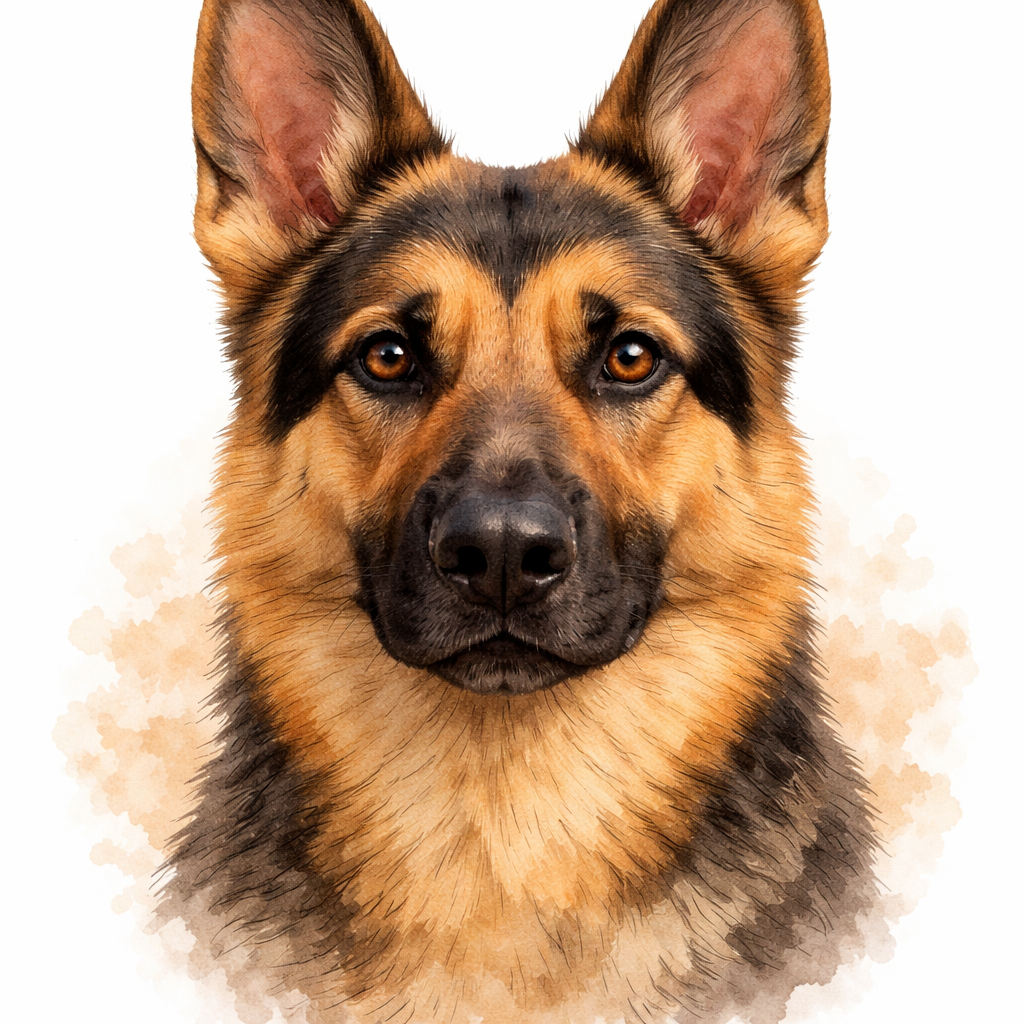
Today the German Shepherd ranks second on the AKC’s most popular breeds list and is the dominant breed in police, military, search-and-rescue, and guide dog programs worldwide. The breed standard describes a dog of 22–26 inches in height and 50–90 pounds in weight, with a distinctive moderately angulated, smoothly curved outline from neck to hindquarters. The most familiar color pattern is the saddle-marked black and tan, though sable and solid black are also recognized. The double coat consists of a dense outer coat and a heavy undercoat that sheds profusely — a characteristic new owners should be fully prepared for.
In Stanley Coren’s intelligence rankings, the German Shepherd ranks third among all breeds, learning new commands in five repetitions or fewer and obeying the first command given approximately 95% of the time.
Temperament & Personality
The German Shepherd’s temperament is defined by a distinctive combination of qualities that makes it uniquely suited to partnership with humans: exceptional intelligence, deep loyalty, controlled courage, and a work ethic that requires daily expression to maintain balance. The AKC breed standard emphasizes that the ideal German Shepherd should have “a direct and fearless, but not hostile, expression” — confident and composed, without being either timid or unnecessarily aggressive.
German Shepherds bond intensely with their family and are notably gentle and patient with children within the household. Their protective instinct is real and strong: they monitor their environment continuously and respond to perceived threats with assertive alertness. This quality is one of the breed’s most valued traits in working contexts, but it means that early, broad socialization is essential for producing a dog that can correctly distinguish between genuine threat and routine social interaction. German Shepherds that receive inadequate socialization can become fearful or reactive, which in a large, powerful breed creates real behavioral challenges.
The breed’s intelligence creates a compelling owner experience — German Shepherds can learn an astonishing range of tasks and commands, and they seem to derive genuine satisfaction from problem-solving and structured work. But this same quality makes them poor candidates for a sedentary lifestyle. A German Shepherd that does not receive sufficient physical exercise and mental stimulation — training sessions, nose work, agility, herding, or other engaging activities — will find its own outlets in destructive chewing, excessive barking, and fence-pacing.
German Shepherds thrive in households where they are treated as full members of the family, given a job to do, and provided with consistent, fair leadership. They are not well-suited to outdoor-only kenneling, and isolation significantly increases the risk of behavioral problems.
Health & Lifespan
German Shepherds have an average lifespan of approximately 11 years, typical for a large breed of their build. The three conditions listed below represent the most clinically significant health challenges the breed faces, though responsible ownership and regular veterinary care can meaningfully extend both lifespan and quality of life.
Hip dysplasia is the most prevalent orthopedic condition in the breed and has been a focus of breeding programs for decades. The OFA and PennHIP programs provide standardized hip evaluations, and reputable breeders screen all breeding dogs before producing offspring. Owners of affected dogs should work with their veterinarian on a management plan that includes weight control (reducing load on the joints), appropriate low-impact exercise such as swimming, and anti-inflammatory therapy. Severe cases may require total hip replacement surgery, which carries a good prognosis in otherwise healthy dogs.
Degenerative myelopathy (DM) is a late-onset neurological disease that typically manifests between 8 and 14 years of age as progressive weakness in the hind limbs, often beginning as subtle stumbling or scuffing. There is no disease-modifying treatment, but regular, consistent physical rehabilitation — including supported walking, swimming, and passive range-of-motion exercises — has been shown to slow functional decline and maintain quality of life. A DNA test identifies dogs carrying the SOD1 mutation associated with increased DM risk. Carriers can still live long, healthy lives; the test’s main value is in guiding breeding decisions.
Exocrine pancreatic insufficiency (EPI) is diagnosed more frequently in German Shepherds than in any other breed. The condition is often manageable with lifelong enzyme supplementation mixed into meals, and most affected dogs respond well to treatment with significant improvement in weight and stool quality. Without treatment, however, affected dogs continue to waste away despite normal or increased food intake, so early diagnosis is important. If a German Shepherd is losing weight despite eating well, an EPI workup should be one of the first steps pursued.
Bloat (gastric dilatation-volvulus) is an additional risk for all deep-chested breeds including the German Shepherd. Feeding two or more smaller meals per day and avoiding vigorous exercise for at least an hour after eating are basic preventive practices.
Frequently Asked Questions
Q: What is the average lifespan of a German Shepherd?
The German Shepherd has an average lifespan of 9–13 years, with a median around 11 years. This large working breed’s longevity is best supported by managing its predisposition to hip dysplasia and degenerative myelopathy through weight management, appropriate exercise, and regular veterinary monitoring.
Q: Is a German Shepherd good for first-time owners?
The German Shepherd can work for first-time owners who are active, consistent, and willing to invest in training and socialization from the start. The breed’s high intelligence and loyalty are assets, but its size, strength, protective instincts, and high exercise needs make it a challenging commitment that requires confident, knowledgeable handling.
Q: How much does it cost to own a German Shepherd per month?
Owning a German Shepherd typically costs $110–190 per month. Budget roughly $50–80 for food, $35–60 for pet insurance (important given hip dysplasia and DM risks), and $25–50 for supplies, training, and routine care. Professional obedience classes are a worthwhile investment for this breed.