History & Characteristics
The Doberman Pinscher is a breed with an unusually precise origin story. In the late 1880s in Apolda, Germany, a tax collector named Karl Friedrich Louis Dobermann set out to create his ideal personal protection dog — one that was loyal, fearless, athletic, and highly intelligent. Having access to the local dog pound as part of his work, Dobermann selectively bred from a variety of working dogs over several years, reportedly including the Rottweiler, German Pinscher, Weimaraner, Manchester Terrier, and Greyhound. The result was a breed that bore his name and embodied his vision: an alert, muscular, versatile working dog with natural protective instincts.
After Dobermann’s death in 1894, breeders — most notably Otto Goeller — continued refining the breed to improve its physical and temperamental consistency. The Doberman Pinscher Club of America was established in 1921. The breed’s capabilities were demonstrated extensively during both World Wars, particularly in scouting and messenger roles. A memorial at the National War Dog Cemetery on Guam honors the Dobermans of the Second Marine War Dog Platoon who served in the Pacific theater.
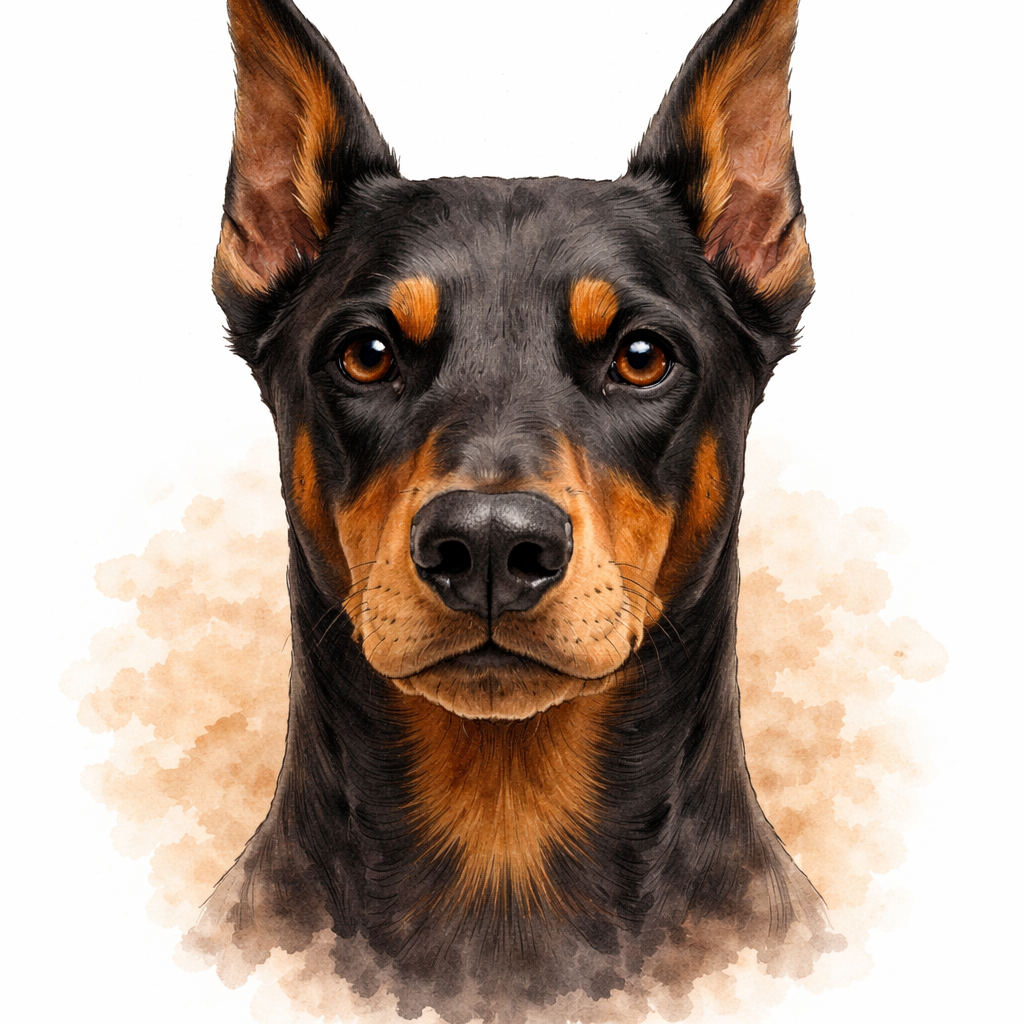
According to the AKC breed standard, the Doberman should present a picture of elegance and substance: compactly built, muscular, powerful, and carrying itself with speed and endurance. Males stand 26–28 inches at the shoulder; females 24–26 inches. The short, close-lying coat comes in four colors — black, red, blue, and fawn (Isabella) — each with rust-colored markings on the muzzle, chest, legs, and beneath the tail. The natural ear is pendant (drop), though ear cropping has historically been practiced in the United States for a more alert, upright appearance. Tail docking is also traditional, though both practices are restricted or prohibited in many countries.
The Doberman ranks fifth among all breeds in Stanley Coren’s canine intelligence assessment, reflecting the breed’s extraordinary trainability and problem-solving ability.
Temperament & Personality
The Doberman’s reputation as a fierce guard dog is substantially overdrawn. A well-socialized, properly trained Doberman is, according to the breed standard, “energetic, watchful, determined, alert, fearless, loyal, and obedient” — a description that captures the breed’s character far better than its menacing pop-culture image. Within the family, Dobermans are known for a degree of affectionate clinginess that surprises many newcomers to the breed. They have been called “Velcro dogs” for their tendency to stay physically close to their owners, often pressing against legs or leaning into a person’s body.
The Doberman’s intelligence is a double-edged quality. These dogs learn extraordinarily quickly, which makes training rewarding and effective when handled with consistency and positive reinforcement. But the same intelligence means that inconsistent leadership, unclear rules, or insufficient mental stimulation will produce a dog that invents its own rules — and a 70-pound Doberman that has decided to run the household is a serious problem.
Socialization during the critical window of 3 to 16 weeks is not optional for this breed — it is essential. Dobermans have a strong protective instinct that, without proper shaping, can develop into excessive wariness or reactivity toward strangers and unfamiliar dogs. Puppy classes, exposure to diverse environments and people, and continued training into adulthood are all necessary.
Dobermans do not thrive with extended isolation. They form intense bonds with their family and are prone to separation anxiety when left alone for long periods. Symptoms can include destructive behavior, excessive vocalization, and self-injurious behavior. Gradual conditioning to alone time beginning in puppyhood is a critical part of raising a well-adjusted Doberman.
Health & Lifespan
The Doberman’s average lifespan of approximately 11 years is closely tied to the breed’s elevated cardiac disease risk. Dilated cardiomyopathy (DCM) is the breed’s most serious health burden. The Doberman Pinscher Club of America estimates that 40–50% of all Dobermans will develop DCM at some point in their lives, and sudden cardiac death caused by ventricular arrhythmia is the leading cause of death in the breed.
DCM in Dobermans frequently enters an “occult” phase — a period that can last years in which cardiac changes are detectable on echocardiography or 24-hour Holter monitoring but no outward symptoms are visible. This makes regular cardiac screening absolutely critical. The DPCA recommends annual cardiac evaluations beginning at age two, including both echocardiography and Holter monitoring. Early detection enables the timely introduction of medications such as pimobendan, which has been shown in clinical trials to delay the onset of overt heart failure.
von Willebrand disease (vWD) is the most common inherited bleeding disorder in dogs, and the Doberman is the most commonly affected breed. Type I vWD in Dobermans is generally mild to moderate, but affected dogs may experience prolonged bleeding after injury or surgery. A DNA test identifies affected and carrier dogs with certainty, and pre-surgical screening should be standard practice.
Hip dysplasia is present at a moderate frequency in the breed. The OFA recommends hip evaluation for all breeding Dobermans. Weight management, controlled exercise during the growth phase, and a diet with appropriate calcium and phosphorus ratios support healthy joint development.
Hypothyroidism, gastric dilatation-volvulus (GDV), and Wobbler syndrome (cervical spondylomyelopathy) are additional conditions for which Doberman owners should maintain awareness. GDV is a surgical emergency: the stomach fills with gas and twists on itself, cutting off blood supply. Feeding two or more small meals daily, avoiding vigorous exercise for at least an hour after eating, and using a slow-feeder bowl are practical preventive measures. Signs of GDV include rapid abdominal distension, unproductive retching, and extreme restlessness — any suspected GDV requires immediate emergency veterinary care.
Frequently Asked Questions
Q: What is the average lifespan of a Doberman Pinscher?
The Doberman Pinscher has an average lifespan of 10–12 years, with a median around 11 years. The breed’s lifespan is significantly influenced by its predisposition to dilated cardiomyopathy and cancer, making annual cardiac evaluations and regular veterinary monitoring essential from middle age onward.
Q: Is a Doberman Pinscher good for first-time owners?
The Doberman Pinscher is generally not recommended for first-time owners without prior experience with large, working-type breeds. The breed requires confident, consistent leadership, extensive early socialization, and daily mental and physical exercise — however, Dobermans that receive this commitment become extraordinarily loyal and responsive companions.
Q: How much does it cost to own a Doberman Pinscher per month?
Owning a Doberman Pinscher typically costs $110–190 per month. Budget roughly $50–80 for food, $35–60 for pet insurance (important given DCM and cancer risks), and $25–50 for supplies and routine care. Annual cardiac evaluations including Holter monitoring add to healthcare costs for this breed.