History & Characteristics
The Basset Hound’s name comes directly from the French word “bas,” meaning “low” or “dwarf” — a perfect description of this ground-hugging hound. The breed’s origins trace to 16th-century France, where monastic breeders — often credited to the friars of the Abbey of St. Hubert — developed a slow-moving, low-slung scent hound capable of trailing game through dense undergrowth with extraordinary persistence. The dog’s low center of gravity allowed hunters on foot to keep pace, making it ideal for the common man who hunted without a horse.
The Basset Hound possesses the second-finest nose of any dog breed, surpassed only by the Bloodhound — its close cousin. Its trailing ability is legendary: the dog works with its nose inches from the ground, using its long ears to funnel ground scent upward and its loose, wrinkled skin to help trap scent particles. After the French Revolution opened hunting to all social classes, the Basset became widely popular among everyday hunters, and its reputation spread rapidly to Britain and eventually the United States.
The AKC first registered the Basset Hound in 1885. The breed became a familiar cultural icon in the United States thanks to the “Hush Puppies” shoe brand mascot and various television appearances. Today, the Basset Hound is recognized in the Hound Group and is beloved for its comical expression, soulful eyes, and patient nature.
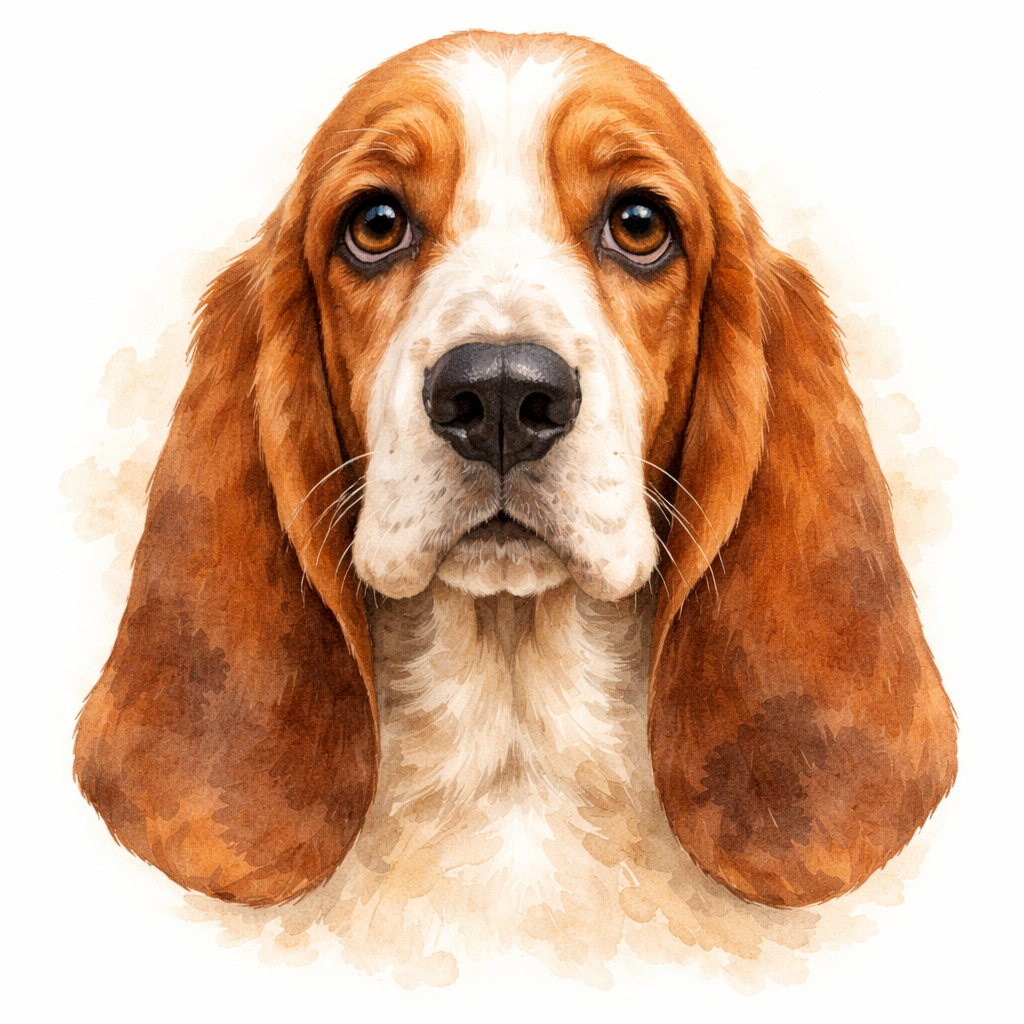
The Basset is a medium-to-heavy dog weighing 20–29 kg (44–64 lbs) despite its low stature. Its most recognizable features are its extraordinarily long, velvety ears that hang well past the muzzle, its deeply wrinkled skin, mournful hazel or brown eyes with a classic “houndy” expression, and its short, bowed legs. The coat is short, dense, and easy to maintain, coming in the classic tricolor (black, white, and tan), lemon and white, red and white, or mahogany and white. The Basset’s distinctive, deep-throated bay — used to signal to hunters while trailing quarry — is one of its most recognizable traits and can carry remarkable distances.
Temperament & Personality
The Basset Hound is a study in contrasts. Indoors, it is the epitome of a relaxed, unhurried companion — content to sprawl across the couch, snore through the afternoon, and accept all the petting offered to it. Outdoors with an interesting scent in its nose, the same dog transforms into a focused, tenacious tracking machine, following a trail with single-minded determination that can make it temporarily impervious to recall commands.
This is a breed with a deeply affectionate nature toward its family. Bassets are notably gentle with children and tend to be patient and tolerant even during boisterous play. They are also social with other dogs and pets, and their low aggression level makes them rarely problematic in multi-pet households. With strangers, Bassets are typically friendly rather than suspicious — though their bay can serve as an effective alert bark.
The Basset’s perceived “stubbornness” is a source of both amusement and mild frustration for many owners. This trait is not a sign of low intelligence; rather, it reflects the breed’s heritage as an independent scenting dog that was bred to make its own decisions in the field. When a Basset doesn’t see the point of what you’re asking, it may simply wait you out. Patience, consistency, and an ample supply of food rewards are the most effective tools for training this breed. Harsh corrections or frustration-based training tend to be completely ineffective.
Bassets are vocal dogs. Their signature bay — a melodious, deeply resonant howl — can be triggered by boredom, loneliness, excitement, or the detection of an interesting smell. For owners in apartments or close-quarters neighborhoods, managing the Basset’s vocal tendencies through training and environmental enrichment is an important consideration.
Health & Lifespan
The Basset Hound has an average lifespan of 12–13 years — respectable for its size. The primary health challenges this breed faces are closely linked to its distinctive anatomy, and proactive management from puppyhood can significantly influence both longevity and quality of life.
Ear infections are the most frequent veterinary complaint for Basset Hounds. No breed has ears that so thoroughly obstruct ear canal airflow, and the result is a chronically warm, moist environment that bacteria and Malassezia yeast find highly hospitable. Without dedicated weekly ear cleaning using a veterinarian-approved solution, infections are essentially inevitable. Signs include odor, dark discharge, head shaking, and ear pawing. Chronic or recurrent infections can progress to involve the middle and inner ear, causing vestibular disease and hearing loss. Owners should also be cautious to dry the ears thoroughly after bathing or water exposure, and food bowls should be narrow enough to keep the ears from dragging through them.
Intervertebral disc disease (IVDD) affects the Basset Hound due to its chondrodystrophic (short-limbed, long-bodied) build. The intervertebral discs in chondrodystrophic breeds calcify and age more rapidly than in other breeds, making them vulnerable to herniation. IVDD can manifest as neck or back pain, reluctance to climb stairs, a hunched posture, and in severe cases, paralysis of the rear limbs. Weight management is the most critical preventive measure — every excess pound places additional stress on an already-taxed spine. Owners should also minimize stair climbing and prevent jumping on and off furniture by providing ramps or steps.
Obesity is a significant concern that amplifies virtually every other health risk the Basset faces. This breed has a strong food drive, a tendency toward low activity, and an unfortunately effective begging expression. Owners must resist overfeeding, measure all meals accurately, limit treats to no more than 10% of daily caloric intake, and ensure daily walks remain a consistent habit. A healthy Basset should have palpable ribs without a thick layer of fat, and a visible waist when viewed from above.
Frequently Asked Questions
Q: What is the average lifespan of a Basset Hound?
The Basset Hound has an average lifespan of 12–13 years, with a median around 12.5 years — respectable for its size. The primary health challenges this breed faces are closely linked to its distinctive anatomy, and proactive ear care and weight management can significantly influence both longevity and quality of life.
Q: Is a Basset Hound good for first-time owners?
The Basset Hound can be a good fit for first-time owners who appreciate a calm, affectionate companion and are prepared for its independent streak. The main challenges are its tendency toward selective deafness during recall, its vocal baying, and the need for consistent weekly ear cleaning — patience and positive reinforcement work best with this breed.
Q: How much does it cost to own a Basset Hound per month?
Owning a Basset Hound typically costs $85–145 per month. Budget approximately $35–55 for food, $30–50 for pet insurance, and $20–40 for supplies and routine care. Ear cleaning supplies and periodic veterinary ear treatments may add to costs for this ear-infection-prone breed.